
Recently, the joint team of Professor Zhang Jinlong from our School of Chemistry and Associate Professor Zhou Liang from our School of Resources and Environmental Engineering published a research achievement titled Peroxymonosulfate activation via non-contact electron transfer process (NCETP) for efficient organic pollutant removal in Water Research, a top journal in the environmental field. This study proposes a new catalytic mechanism named non-contact electron transfer process, which exhibits extremely high pollutant degradation efficiency and selectivity in Fenton-like reactions, providing a brand-new idea for the development of high-efficiency water treatment technologies.
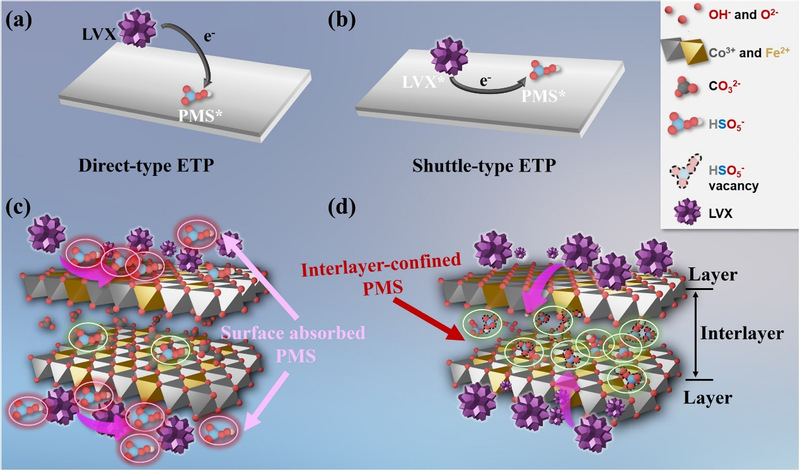
The residues of antibiotics such as levofloxacin (LVX) in water bodies have become a global environmental problem. Although sulfate radical-based advanced oxidation processes can degrade such pollutants, the traditional radical pathway has problems such as short lifespan, susceptibility to water quality interference, and low oxidant utilization rate. As a non-radical pathway, the electron transfer process has the advantages of high selectivity and strong anti-interference ability, but it still faces challenges such as low electron transfer efficiency and many side reactions in practical applications. This study proposes the non-contact electron transfer process (NCETP) for the first time in the layered double hydroxide/peroxymonosulfate (LDH/PMS) system. Different from the traditional electron transfer process, NCETP realizes the physical isolation of pollutants and oxidants on both sides of the catalyst: PMS is confined between the LDH layers, while macromolecular pollutants such as LVX are adsorbed on the outer surface of the catalyst, so the two cannot be in direct contact. Through the ingenious memory effect and ion exchange strategy, the researchers successfully constructed a CoFe LDH catalyst (CLHSO) with HSO₅⁻ vacancies, enabling it to preferentially adsorb and anchor PMS between the layers. The interlayer-confined microenvironment not only increases the local concentration of PMS, but also achieves efficient electron transfer through the hydrogen bridge structure. Experiments show that the number of electron transfers in the NCETP process is 2.58 times higher than that in the traditional ETP, and the degradation rate of LVX exceeds 95% within 30 minutes. In addition, the system remains efficient and stable in a wide pH range (5~11) and under complex water quality conditions. To verify the practical application potential of this technology, the team constructed a continuous flow reactor using CLHSO-loaded polyester fiber as the filler. During 24 hours of continuous operation, the degradation rate of LVX by the system was always maintained above 99%, and the metal leaching concentration was far lower than the national emission standard. In addition, the chromaticity of the dye wastewater treated by the continuous flow system decreased significantly. Toxicity assessment shows that the ecotoxicity of the degradation products is significantly lower than that of the original LVX drug, and the treated solution has a complete inactivation effect on Escherichia coli, showing good environmental friendliness.
East China University of Science and Technology is the sole corresponding unit of the paper. Doctoral students Pei Wenkai and Hao Chenchen from the School of Resources and Environmental Engineering are the co-first authors, and Professor Zhang Jinlong and Associate Professor Zhou Liang are the corresponding authors. The research also received careful guidance from Professor Liu Yongdi and Professor Lei Juying, and was supported by projects such as the National Key R&D Program and the National Natural Science Foundation of China.
Original link:
https://www.sciencedirect.com/science/article/pii/S0043135425016999#fig0001