
Recently, the 2025 Science and Technology Award Conference of the China Petroleum and Chemical Industry Federation was grandly held in Beijing. The conference commended scientific and technological workers and innovative achievements that have made outstanding contributions to the high-quality development of China's petroleum and chemical industry. The project Construction of High-resolution Source Profiles of Volatile Organic Compounds and Application of Rapid Traceability in Industrial Zones, led by Professor Xiu Guangli of the School of Resources and Environmental Engineering, won the second prize of the Science and Technology Progress Award (including basic research category).
Project Name: Construction of High-resolution Source Profiles of Volatile Organic Compounds and Application of Rapid Traceability in Industrial Zones
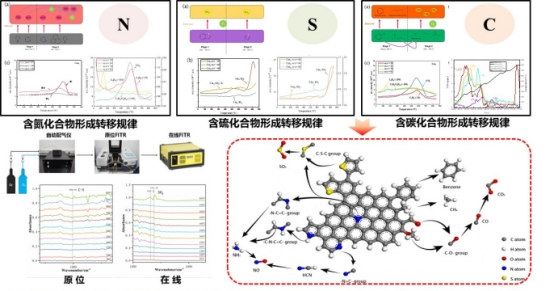
▲ Construction of high-resolution source profiles for catalytic cracking
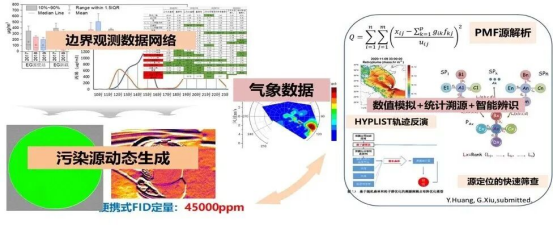
▲ Two-way comprehensive traceability model
Project Introduction:
Volatile organic compounds (VOCs) are common precursor pollutants of PM₂.₅ and ozone, and some of them are characterized by health risks and odor nuisance. Therefore, accurate traceability and scientific treatment of VOCs in chemical parks are very challenging. Focusing on the pain points of VOCs systematic management and control in chemical parks, this project has built a closed-loop technical system of source profile - monitoring - traceability - management and control, and achieved a series of innovative results. This project is led by East China University of Science and Technology, and completed jointly with units including CNPC Research Institute of Safety & Environment Technology, Shanghai Chemical Industry Park Management Committee, Shanghai Academy of Environmental Sciences, Shanghai Environmental Monitoring Center, and Shanghai Chemical Industry Environmental Protection Monitoring Station.
On the basis of existing conventional source profile measurement methods, the project team has innovatively developed a qualitative and semi-quantitative method for unknown VOCs, established a database covering more than 400 species, which can identify more than 30 characteristic odor substances; based on process mechanism and field measurement verification, the project team has constructed the molecular-level full-component source profile of catalytic cracking units for the first time in China, filling the gap in domestic comprehensive emission factors, and forming a device-scale refined VOCs source profile covering organized, unorganized and unconventional emissions. By integrating technologies such as tethered balloon vertical sampling and mobile observation, the project team obtained the vertical distribution profile of VOCs in Hangzhou Bay for the first time, and identified the regional diffusion and transport characteristics; The team has innovatively developed source identification technology based on chemical characteristic components and meteorological inversion positioning technology based on observation data, and integrated multiple models, increasing the traceability accuracy to about 80%. It has taken the lead in proposing the monitoring limit for unorganized VOCs emissions in factory areas internationally, which has been adopted and referenced by national environmental protection standards and local standards of multiple provinces and cities such as Jiangsu, providing an effective management and control path for unorganized VOCs emissions. The project has formulated 12 standards and specifications, including the first domestic technical specification for VOCs mobile monitoring.
Since its application in 2016, the project achievements have served VOCs treatment work in many regions such as Shanghai, Suzhou High-tech Zone, and Dezhou, Shandong. The ambient VOCs concentration in Shanghai Chemical Industry Park has decreased by 54%, and the number of regional high-value alarms has dropped by more than 56%. This achievement provides key technical support for breaking through the technical bottleneck of VOCs systematic management and control in industrial zones and promoting the modernization of the ecological environment governance system and governance capacity.