
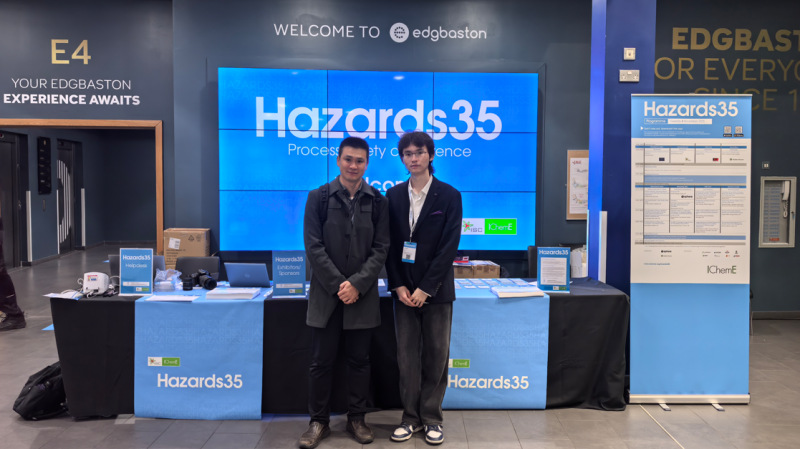
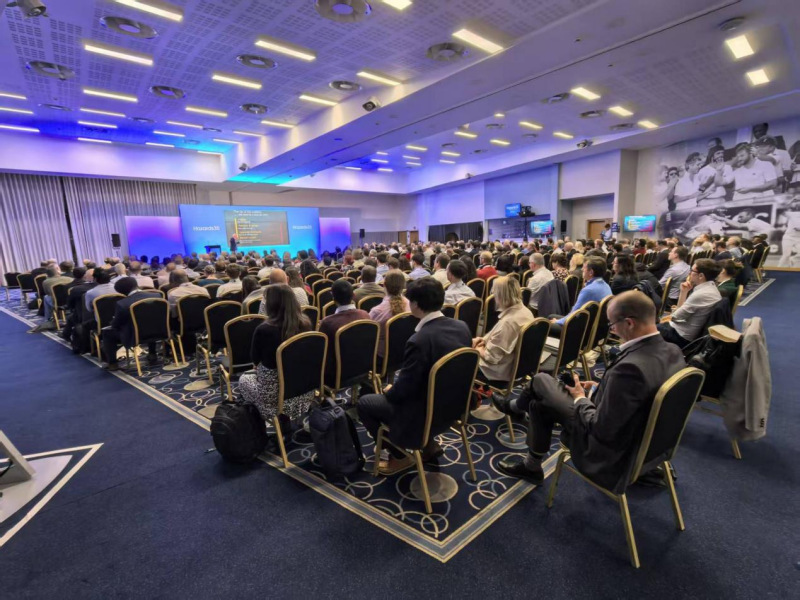
Recently, Professor Sheng Min, Director of the Reaction Safety Center, led a team to Birmingham, UK, to attend the Hazards 35 International Conference on Process Safety hosted by the Institution of Chemical Engineers (IChemE). The three-day conference brought together experts, scholars and enterprise representatives from countries and regions in Europe, America, Asia-Pacific and other regions, and carried out presentations and discussions around themes such as process safety management, reaction safety, safety regulations, and risk governance and modeling.
During the conference, Sheng Min gave a special report titled Latest Updates of ASTM E537-24 in DSC Test Methods, interpreting the key points of the standard revision and the implementation path. The report proposed a DSC test scheme that replaces the traditional aluminum crucible with a glass capillary crucible, which overcomes problems such as limited open/closed options, low high-pressure resistance, and sample oxidation caused by air headspace. Compared with aluminum crucibles, glass crucibles have advantages such as low cost, visibility before and after testing, low rupture risk and lighter damage, more stable baseline, easier identification of decomposition peaks, elimination of air oxidation peaks, and more accurate assessment of the total calorific value of high-energy chemicals, which can alleviate the deviation caused by sample vaporization and improve the accuracy and repeatability of test data.
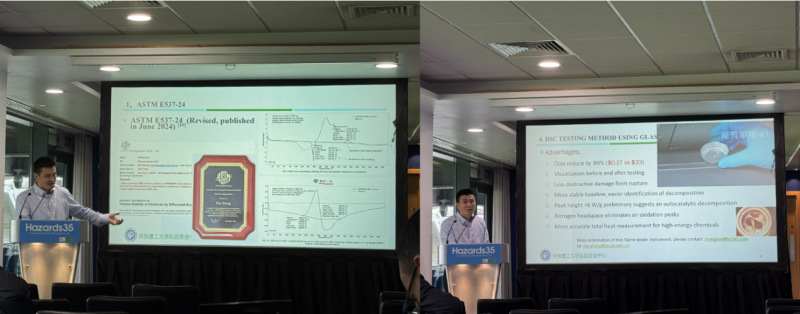
The content of the report is cutting-edge, highly targeted and operable, and has received extensive attention and positive evaluation from participating experts and enterprise representatives. Many representatives from enterprises and testing institutions gave positive feedback on the standard application and collaborative verification. The conference organizing committee affirmed the exemplary role of the report in promoting the standardization of DSC testing and the safety assessment of high-energy chemicals.
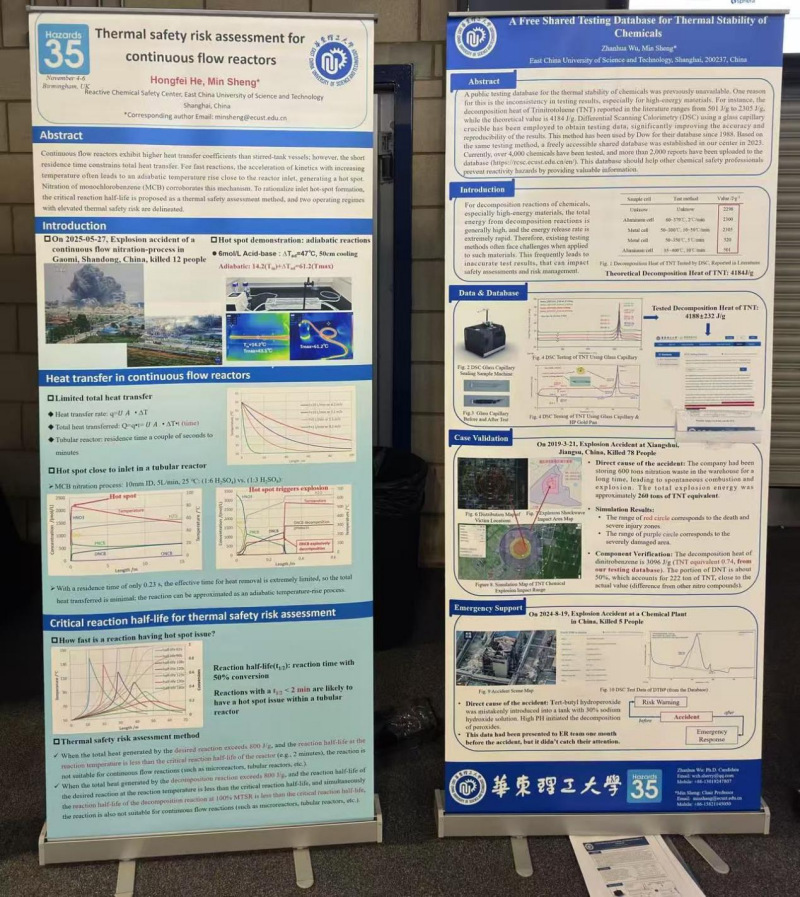
During the conference, members of the center presented a poster themed Reaction Safety Risk Assessment of Continuous Flow Reactors, explaining the formation mechanism of hot spots at the inlet of continuous flow devices, the proposal and verification of the critical half-life criterion, and the comprehensive risk assessment path based on the coupling of calorimetry, kinetics and heat transfer. The display content combined experimental data and numerical simulation results, provided the curves of temperature, concentration and conversion rate inside the reactor under typical working conditions, and formed the model calculation results under abnormal working conditions. Meanwhile, the Free Shared Test Database for Chemical Thermal Stability displayed by the team introduced the advanced test methods and standards of the database, as well as accident analysis cases based on the data in the database. The database provides key parameters such as initial decomposition temperature and total decomposition heat of more than 2,000 hazardous chemicals every year, and is open to universities, enterprises and regulatory authorities for use. The database supports retrieval by substance category and provides corresponding sample test reports. The poster display attracted widespread attention, and members of the center conducted in-depth exchanges with more than 30 international counterparts on the research content of the poster on site.
In addition to the poster exchanges, members of the center also attended more than 20 conference reports and special lectures, which focused on topics such as human factors in the chemical and process industry, regulatory and governance frameworks for runaway reactions, modeling of pressure relief devices and vessel assessment, credibility of CFD-based explosion simulation and VVUQ research, reduction of fugitive emissions through optical fiber monitoring technology, and the world's largest chemical interaction matrix.
This participation and exchange of the center's members demonstrated the center's latest achievements in continuous flow reaction safety and thermal stability testing standardization, and consolidated the foundation for exchanges and cooperation with the international academic and industrial communities. The consensus reached around standard revision, data sharing and model implementation will be directly applied to the iterative improvement of the center's subsequent test specification optimization. Taking this conference as a new starting point, the center will promote collaborative verification and joint research with multiple universities, testing institutions and enterprises, continue to deliver high-quality technical achievements and industry guidelines, and serve the country's major safety needs and the improvement of the intrinsic safety level of the chemical industry.