
Recently, the research group led by Qiu Kaipei from the Key Laboratory of Environmental Risk Assessment and Control for Chemical Processes of the Department of Ecology and Environment, School of Resources and Environmental Engineering of our university, has made a breakthrough in the field of artificial intelligence + single-molecule environmental analytical chemistry, realizing standard-free quantitative detection of ultra-trace per- and polyfluoroalkyl carboxylic acid compounds in complex environmental media. The relevant research results, titled Machine learning assisted single-molecule sensing towards standard-free quantification of per- and polyfluoroalkyl carboxylic acids were published in Nature Communications.
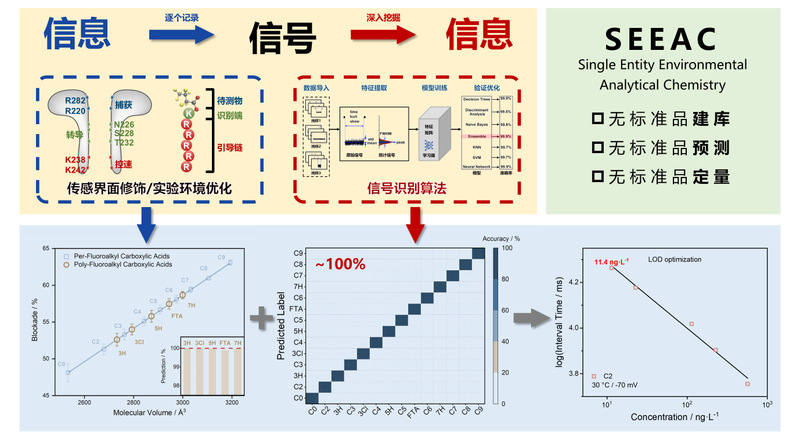
Per- and polyfluoroalkyl substances (PFAS) are a category of emerging pollutants that are of particular concern. Currently, there are more than 15,000 PFAS with known structures, and quantitative analysis of the occurrence characteristics of PFAS in different environmental media is of vital importance for deciphering their migration and transformation rules, ecological health risks, etc. Due to the extreme shortage of commercial standard substances (less than 1% of the total), targeted detection technologies such as chromatography-mass spectrometry are difficult to achieve full coverage of PFAS, while the quantitative analysis accuracy of non-targeted screening technologies such as high-resolution mass spectrometry still remains to be verified. Single-molecule analysis based on nanopore electrochemistry, with its ultra-high structural resolution brought by the near-field signal transduction mode, can achieve high-fidelity recording of the structural information of the analyte molecules passing through the pore (from information to signal); combined with the multi-feature single-molecule classification algorithm (from signal to information), the types of PFAS molecules passing through the pore can be accurately identified one by one. By measuring the pore translocation frequency of the corresponding molecules, simultaneous quantitative analysis of multiple ultra-trace PFAS homologues and even isomers can be achieved even when there are a large number of interfering substances with extremely high concentration differences and minimal structural differences in the complex environmental media.
Based on the above strategy, the team used the Aerolysin nanopore system to conduct research on standard-free detection of per- and polyfluorinated carboxylic acids (PFCAs) guided by oligoarginine chains. Through the construction of the characteristic current - molecular volume linear structure-activity relationship for PFCAs, and combined feature engineering with machine learning algorithms, 100% accurate identification of 13 types of PFCAs was achieved. Further, molecular dynamics simulation was used to guide the channel design, and the probe-driven capture strategy was strengthened. A unified quantitative calibration curve covering nearly half of PFCAs was realized at the experimental level, and the detection limit for trifluoroacetic acid was reduced to the level of 10 ng/L. Finally, the anti-interference test results in different environmental media (including tap water, serum, and various coexisting pollutants such as fatty acids, antibiotics, and heavy metal ions) showed that the qualitative and quantitative capabilities of single-molecule analysis were not affected. Recent relevant research by the group has further expanded the standard-free qualitative identification of PFCAs to 10 categories and more than 80 types of PFCAs, and expanded the standard-free quantification to cover all PFCAs with a minimum detection limit of 1 pM, laying a foundation for the development of on-site rapid detection technologies for PFAS.
East China University of Science and Technology is the sole corresponding unit of the paper. Associate Professor Qiu Kaipei from the School of Resources and Environmental Engineering is the sole corresponding author, and master's graduates Zuo Jiaqi, Li Hongshuang and Tang Wen serve as co-first authors. The research work was supported by projects such as the National Natural Science Foundation of China, the National Key Research and Development Program of China, and the Natural Science Foundation of Shanghai.
Original link: https://doi.org/10.1038/s41467-026-70718-3.