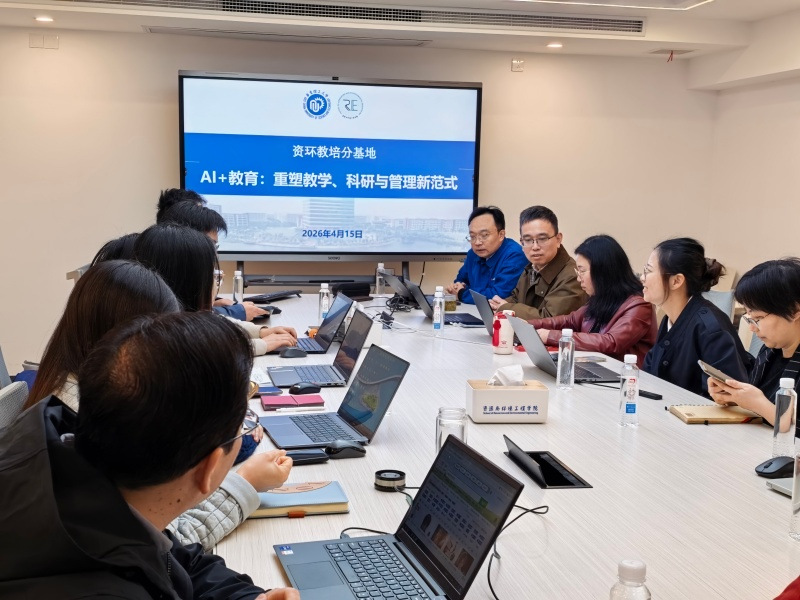
To keep pace with the development of the intelligent era, promote the in-depth integration of AI technology with the whole scenarios of work, teaching and learning, and improve the efficiency and quality of daily work and study, the Teacher Training Base of the School of Resources and Environmental Engineering held an AI tool application experience sharing session on April 15. Centered on the themes of practicality, high efficiency and empowerment, this sharing session invited Mr. Xu Hongyong, Deputy Director of the Laboratory and Equipment Division who has been deeply engaged in AI application practice in the university, as the guest speaker. Chen Xueli, Deputy Secretary of the Party Committee of the School of Resources and Environmental Engineering, Sun Xianbo, Vice Dean of the school, young teachers from the training sub-base and some teachers of professional courses attended the sharing session. The meeting was chaired by Sun Xianbo.
At the sharing session, Xu Hongyong combined his own frontline practical experience, focused on the application of AI tools in different scenarios, and shared application skills and experience without reservation through a combination of specific cases and practical demonstrations, so that participants could intuitively experience the convenience and high efficiency of AI technology. In terms of work application scenarios, the session focused on the improvement of office efficiency, and introduced in detail the practical practices of AI tools in daily office work: use AI document tools to quickly generate documents such as work summaries and notices, optimizing language logic and correct format errors with one click; use AI data tools to automatically organize tables and analyze data trends, replacing tedious manual statistical work; intelligently plan work arrangements and set up event reminders through AI schedule management tools, avoiding missing important work. In the teaching application section, he shared how AI tools could improve quality and efficiency for classroom teaching: use AI tools to generate theme expansion materials and design classroom interactive Q&A, enriching teaching content and stimulating students' learning interest; use AI courseware tools to make dynamic demonstration courseware, and visualize abstract mathematical formulas and geometric figures, helping students quickly understand key and difficult points; use AI to quickly analyze students' assignment and test data, identify students' learning shortcomings, and provide data support for stratified teaching and personalized tutoring, making teaching more targeted.
Xu Hongyong also specially emphasized that when using AI office tools, it is necessary to adhere to the bottom line of data security, properly keep confidential information, reasonably use tools to assist work, and avoid the degradation of independent ability caused by excessive dependence. In the sharing process, the participants listened carefully, interacted actively, took the initiative to record practical skills, and consulted the guest on questions they encountered in the application of AI tools. The on-site exchange was conducted in a warm and harmonious atmosphere, where participants engaged in in-depth discussions and drew inspiration from each other, all stating that they had gained a great deal. Many participating faculty and staff noted that this sharing session had resolved their confusions in the application of AI tools, and they had learned many practical skills. In the future, they will proactively attempt to integrate AI tools into their daily work to improve work efficiency.