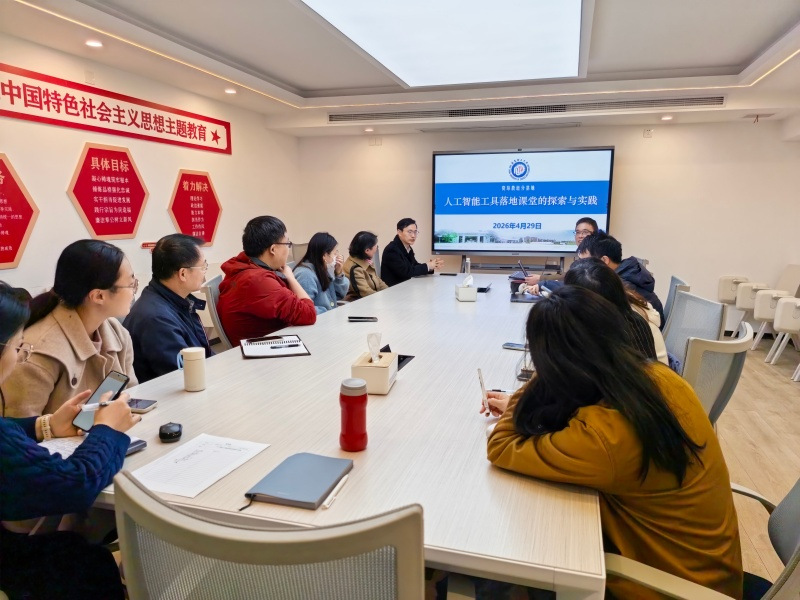
Under the tide of the era when artificial intelligence (AI) is fully integrated into education, how to enable AI technology to truly enter classrooms, serve teaching and benefit students has become a core issue of higher education reform. On the morning of April 29, the School of Resources and Environmental Engineering, together with the Jiangxin Counselor Studio, invited Professor Chen Jianjun, Vice Dean of the School of Mechanical and Power Engineering, to give a lecture titled Exploration and Practice of Implementing Artificial Intelligence Tools in Classrooms. Cao Na, Deputy Secretary of the Party Committee of the School of Resources and Environmental Engineering, Sun Xianbo, Vice Dean of the school, young teachers from the teacher training sub-base and some professional course teachers, as well as counselors from the university's Psychological Counseling Center and brother schools such as the School of Resources and Environmental Engineering, the School of Business and the School of Chemistry, attended the meeting to learn together. The meeting was chaired by Sun Xianbo.
Taking the course Fundamentals of Process Equipment Mechanical Design he teaches as an example, Professor Chen Jianjun explained in detail how to rely on AI tools to solve the problems existing in the course, such as broad and scattered content, difficulties for students in constructing a knowledge system, delayed assignment feedback, and lack of personalized learning, and achieved the good effects of intelligent teaching resource generation, diversified teaching form expansion and personalized learning implementation, providing replicable and popularizable practical experience for university teachers to promote the digital transformation of education at low cost and high efficiency.
In terms of teaching resource construction, after teachers upload textbook files, AI can quickly extract chapter content, automatically generate importable standardized mind maps, and generate knowledge graphs in batches based on the university's informatization platform, covering more than 100 levels of knowledge point correlations, improving the efficiency of knowledge structured sorting. Meanwhile, by standardizing prompt instructions, AI can generate question bank questions in batches according to the platform template, which can be directly imported into the teaching system for use. In response to problems such as AI content recognition errors, teachers can also introduce a student participation error correction mechanism, combined with regular score incentives, to improve the quality of resources while enhancing students' learning participation. In terms of teaching form expansion, AI technology has broken the boundaries of traditional classrooms. With the help of free voice cloning and video translation tools, Chinese MOOCs can be automatically converted into multilingual versions. For the abstract and difficult points of engineering courses, AI can generate interactive and structural animations, so that students can intuitively observe the change of principles, making complex knowledge visualized and easy to understand, and enhancing the attractiveness of classroom teaching. In practical application, Professor Chen also shared his strategies and experience in using AI . For example, the carrot and stick mode works best when interacting with AI : Polite language can improve the quality of replies, while strict instructions can make AI focus on core issues; meanwhile, it is necessary to clarify the output format requirements, cultivate students' ability to identify AI hallucination errors, and guide students to shift from single shallow question and answer to multi-round deep interaction, turning AI into a learning assistant.
The exchange session was held in a warm atmosphere. The participating teachers shared and discussed problems encountered and usage tips related to the AI tools they use, and gained a lot from the activity. All attendees agreed that AI is not a replacement for teachers, but an enabler of teaching. The core value of teachers has shifted from knowledge impartation to learning guidance, framework construction and interaction design, and teachers are irreplaceable in aspects such as individualized teaching, emotional communication and thinking cultivation. In the future, with the continuous upgrading of large model technology, higher education will take AI tools as the fulcrum to promote the all-round innovation of teaching concepts, teaching methods and teacher-student roles, so that intelligent technologies can serve the fundamental task of fostering virtue through education and open a new chapter of high-quality education and teaching.