
Recently, our Institute of Clean Coal Technology of the School of Resources and Environmental Engineering has made new progress in the field of combustion reaction kinetics. The study reveals the mechanism of key chain-branching reactions in the low-temperature oxidation process of toluene, constructs a detailed reaction kinetic model suitable for low-temperature combustion conditions, and deepens the understanding of the low-temperature oxidation chemistry of aromatic hydrocarbons, providing an important theoretical basis for the clean and efficient combustion of complex fuels such as transportation fuels, coal and biomass, as well as pollutant emission reduction. The relevant achievement, titled Unraveling low-temperature chain-branching chemistry in toluene oxidation, has been published in Proceedings of the Combustion Institute, an authoritative journal in the international combustion field.
Aromatic hydrocarbons are not only important components of petroleum-based transportation fuels, but also important structural units and key intermediates in the thermochemical conversion process of coal and biomass. As the simplest side-chain aromatic hydrocarbon, toluene is not only an important component of gasoline, but also an important precursor of tar and various aromatic products in the combustion and gasification processes of coal and biomass. An in-depth understanding of the low-temperature oxidation reaction mechanism of toluene is of great significance for revealing the initial combustion process of complex fuels and the formation and evolution laws of pollutants such as tar and carbon black. However, existing studies mainly focus on the high-temperature combustion chemistry of toluene, and there is still a lack of systematic understanding of its low-temperature chain-branching reaction mechanism and its impact on combustion characteristics.
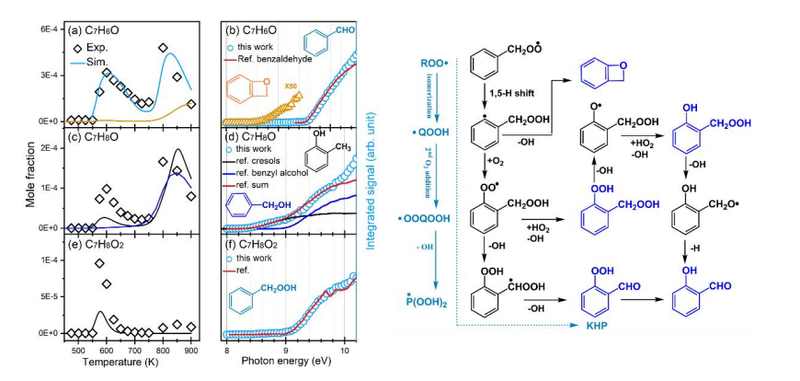
To address this scientific issue, a systematic study on the low-temperature oxidation process of toluene was carried out using a jet-stirred reactor experimental platform, combined with molecular beam sampling photoionization mass spectrometry, quantum chemical calculation and detailed reaction kinetic simulation. Through the construction of a lean-burn toluene/dimethyl ether mixed fuel system, the low-temperature oxidation reactivity of toluene was enhanced, and more than 40 key reaction intermediates were detected, including free radicals, oxygen-containing aromatic compounds and various highly oxidized intermediates. On this basis, a kinetic model for the low-temperature oxidation of toluene was established and improved, which reproduced the evolution law of main species and the ignition delay time. Combined with reaction path analysis, the study revealed for the first time the key low-temperature chain-branching reaction processes such as the isomerization of benzyl peroxy radicals (ROO), the evolution of QOOH radicals and secondary oxygen addition, and clarified the low-temperature oxidation reaction network of toluene and its control mechanism.
The first author of the paper is Associate Professor Yuan Wenhao from the Institute of Clean Coal Technology, and the corresponding authors are Professor Wang Fuchen and Professor Yu Guangsuo from the Institute of Clean Coal Technology. The research work was supported by the National Natural Science Foundation of China projects. Proceedings of the Combustion Institute is the official journal of The Combustion Institute, as well as a top international journal in the field of combustion science and technology, which mainly publishes papers accepted by the International Symposium on Combustion. The International Symposium on Combustion is the largest and most influential international academic conference in the combustion field, known as the Olympic event in the combustion community, and is held every two years. Symposium papers need to go through a strict two-round peer review process: After the paper is accepted, the author must give an oral presentation or poster display in the relevant session of the Symposium, and after the second round of peer review following the Symposium, the paper is finally published in Proceedings of the Combustion Institute.
Paper link: https://www.sciencedirect.com/science/article/pii/S1540748926002191